
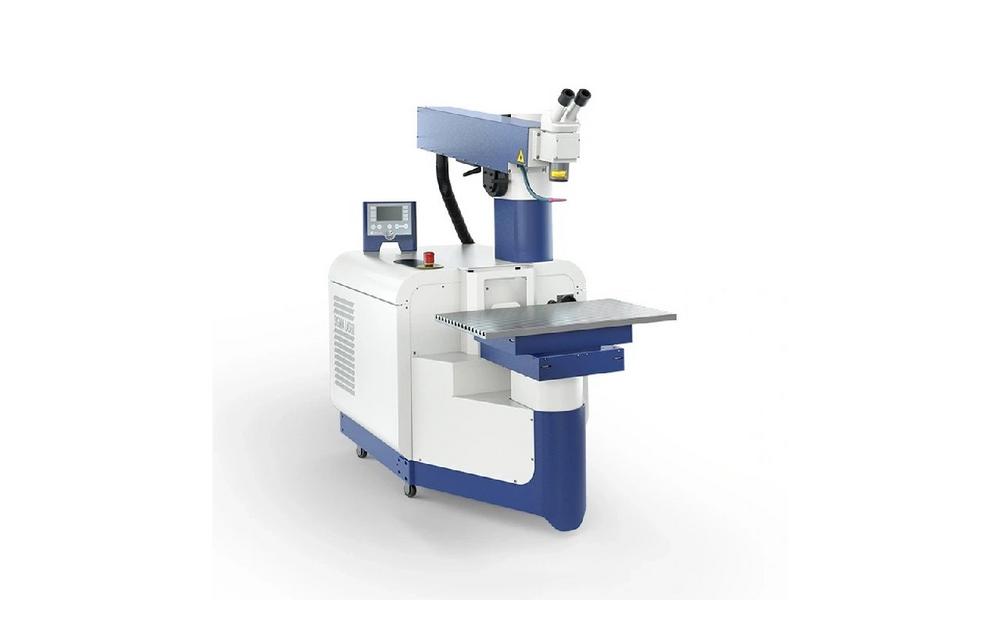
A chipped sealing face on a grey-iron pump housing is a common workshop challenge. If the spare part will not arrive for weeks, the question is whether the laser can restore function and surface. The answer depends on the type of cast iron, the location of the damage and the process used. The guide to laser welding cast iron explains the background; here, the focus is on what can be repaired, what cannot, and how the three main process levers decide over success.
Cast iron cracks because of carbon, graphite and hard phases on cooling
Cast iron contains a high proportion of carbon and free graphite. During welding, carbon dissolves in the melt. On rapid cooling, hard and brittle phases such as ledeburite and martensite can form in the seam and the heat-affected zone. This makes the material prone to hardening cracks and creates zones that are difficult to machine.
Ductile iron, with its spheroidal graphite structure, welds more reliably than grey cast iron, which contains flake graphite and cracks most readily. Malleable iron sits between the two in weldability.
Small repairs are possible; structural joints are not
Laser welding is suitable for small repairs where the casting is not highly loaded. Typical applications include:
- Chipped edges and sealing faces
- Cavities and pores on visible surfaces
- Thread areas
- Housings and machine beds in non-load-bearing spots
Structural joints and areas under high dynamic load are not suitable for repair by welding. In these cases, replacing the part is the honest answer.
Pre-heating, filler metal and low heat input decide over cracks
The risk of cracks can be reduced by three main process levers. Pre-heating the casting and allowing it to cool slowly and evenly limits thermal stresses and hardening. A nickel-based filler metal remains ductile and binds carbon, reducing the formation of brittle phases. Low, controlled heat input – achieved with pulsed Nd:YAG or fibre lasers using Super Pulse Technology – keeps the heat-affected zone small.
Preparation is also critical: the surface must be bright metallic, with all graphite and oil residues removed, and cracks ground out. The seam is built up in small pulses with pauses to allow cooling.
"Every successful cast iron repair starts with careful preparation and a test weld on the actual material," says Alexander Bellouzi, Senior Design & Engineering at Sigma Laser.
"This is the only way to assess seam quality and crack-freedom before the real repair."
A practical next step is to review the repairing cast parts with porosity, cavities and cold shuts guide and arrange a sample weld on your own cast iron. This shows whether the repair will hold in your specific case.
Sigma Laser has developed and manufactured industrial laser welding systems in Hanau, Germany, since 2005. The range comprises six five-axis systems – mobile (Sineo Light, Sineo Fibre, Sirius Light) and stationary (Sidanus Light, Sidanus Fibre, Siega Fibre) – with Nd:YAG (1064 nm) or fibre laser sources (1070 nm), complemented by Simass automation modules and Super Pulse Technology. The Sineo system won the German Design Award 2025; customers are located in more than 25 countries.
Sigma Laser GmbH
Pfaffenbrunnen Str. 158
63456 Hanau-Steinheim
Telefon: +49 (0)6181 413 6679
https://sigma-laser.com
